


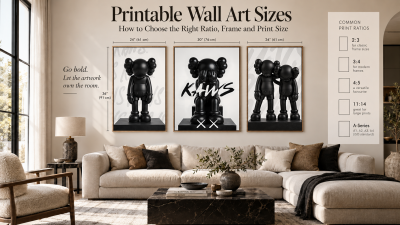
Printable Wall Art Sizes: How to Choose the Right Ratio, Frame and Print Size
You've found artwork you love, downloaded the files, and picked a frame.
Then you see five different print ratios.
2:3. 3:4. 4:5. 11:14. ISO A.
What do they actually mean? And which file should you use?
The good news is that choosing the right printable wall art size is much simpler than it looks once you understand the difference between aspect ratio and print dimensions.
This guide explains the most common sizes, how to choose between them, and how to print a coordinated set of three without awkward cropping or stretched artwork.
1. What Is a Print Aspect Ratio?
An aspect ratio describes the relationship between an image's width and height.
For example, a 2:3 ratio means the image is two units wide for every three units high.
A 12 × 18 inch poster and a 24 × 36 inch poster share the same 2:3 ratio. They're different sizes, but their proportions are identical.
That matters because an image prepared for a particular ratio can be resized to another dimension with the same ratio without changing its composition.
If you force a 2:3 image into a 4:5 frame, however, you'll need to crop some of the image, introduce borders, or distort it.
Distortion is generally the worst option because it stretches the artwork.
The simplest rule: match the image ratio to the frame ratio before printing.
2. The Five Print Ratios Explained
Lazy Lion Club digital wall art collections include five print-ratio options to accommodate common framing formats.
| Ratio | Available sizes | Typical use |
|---|---|---|
| 2:3 | 12×18, 16×24, 20×30, 24×36 in | Larger vertical posters |
| 3:4 | 9×12, 12×16, 18×24, 24×32 in | Medium and large framed art |
| 4:5 | 8×10, 16×20, 24×30 in | Balanced portrait artwork |
| 11:14 | 11×14, 22×28 in | Popular portrait frame format |
| ISO A-Series | A5, A4, A3, A2, A1 | Standard paper sizes in many countries |
These are the available dimensions for our five supplied file formats. They're not a promise that every commercial printer or frame manufacturer stocks every size.
All dimensions in inches are listed as width × height for portrait-oriented prints.
2:3 Ratio — The Classic Poster Format
The 2:3 ratio is especially useful for larger vertical artwork.
A 24 × 36 inch print creates a substantial wall display and works well above furniture or in rooms with taller walls.
The same composition can also be printed at 12 × 18 inches for smaller spaces.
3:4 Ratio — A Versatile Framing Option
A 3:4 print is slightly wider in proportion to its height than a 2:3 print.
Common sizes include 12 × 16 and 18 × 24 inches.
It's a practical choice for bedrooms, home offices, and three-piece gallery walls.
4:5 Ratio — A Balanced Portrait Format
The 4:5 ratio works well for artwork with a central subject or a more compact portrait composition.
Sizes such as 8 × 10 and 16 × 20 inches are useful for smaller displays and framed collections.
11:14 Ratio — For Specific Frame Sizes
This format is designed for 11 × 14 and 22 × 28 inch printing.
It's especially useful if you already own frames in those dimensions.
Although 11:14 and 4:5 look similar, they aren't mathematically identical. Choose the correct folder for your frame.
ISO A-Series — International Paper Sizes
The A-Series includes A5, A4, A3, A2, and A1.
These sizes are widely used by printers and paper suppliers in Europe and many other markets.
They're especially convenient when ordering from a local print shop that works in millimeters rather than inches.
3. How Big Should Your Wall Art Be? Don't Be Afraid to Go Bold
Wall art shouldn't always be a subtle finishing touch. Sometimes, it should be the first thing people notice when they enter a room.
If you want your artwork to become the focal point of the space, go big.
A coordinated set of three large prints can completely change the visual balance of a living room, bedroom, or home office. Instead of filling an empty wall, you're creating a statement feature that defines the room's character.
Make Your Gallery Wall the Main Attraction
For a striking arrangement above a sofa, bed, or large console, consider:
-
16 × 24 inches: A substantial three-piece arrangement that works in many medium-sized rooms.
-
20 × 30 inches: A strong statement size, ideal for making artwork a dominant feature.
-
24 × 36 inches: Maximum visual impact for spacious rooms and large feature walls.
Three 24 × 36 inch prints displayed side by side can transform an ordinary wall into a gallery-like installation.
And bigger doesn't necessarily mean busier. Large monochrome artwork can look remarkably refined, while oversized colorful prints bring energy and personality to a neutral interior.
Think Beyond Filling Empty Space
If your goal is a quiet accent, smaller prints can work beautifully.
But if you want the artwork to establish the room's atmosphere, choose a size that commands attention.
As a starting point, a gallery wall above furniture often looks balanced when the complete arrangement occupies approximately two-thirds to three-quarters of the furniture's width. You can go wider for a more dramatic effect, provided the wall has enough space.
Before ordering, measure your wall and account for the full width of all three frames, including the gaps between them.
Our advice? When you have the wall space and want a real statement, don't automatically choose the smaller size. Let the artwork own the room.
4. How to Arrange a Set of Three Prints
A coordinated set of three is one of the simplest ways to build a gallery wall.
The artwork has already been designed to work together, so you don't need to search for three unrelated posters that share the same colors or style.
For a classic horizontal layout, use three frames of the same size, align their top and bottom edges, and leave consistent spacing between them.
A gap of approximately 2–4 inches between frames is a useful starting point for many medium-sized displays, although you can adjust it to suit the wall.
For a vertical arrangement, stack smaller prints on a narrow wall or beside a tall piece of furniture.
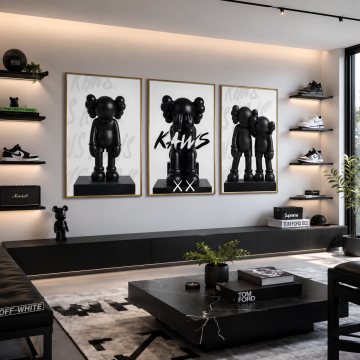
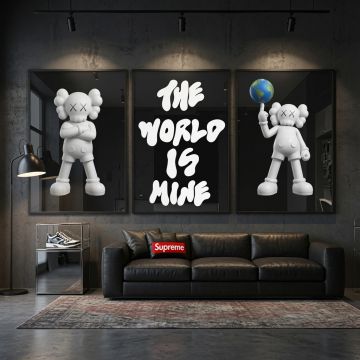
Our Black & White KAWS Wall Art Set of 3 is one example of a coordinated collection suited to a monochrome gallery wall.
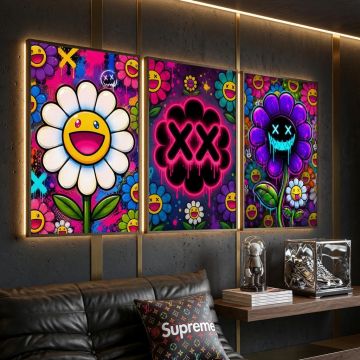
For a brighter space, the Colorful Abstract KAWS Set combines coordinated abstract backgrounds and character artwork.
5. What Does 300 DPI Actually Mean?
DPI stands for dots per inch. In digital printing workflows, the term is commonly used when discussing the intended print resolution of an image.
For a digital image, the actual pixel dimensions are essential.
At 300 pixels per inch, a 12 × 18 inch print would require 3,600 × 5,400 pixels.
A 24 × 36 inch print at the same pixel density would require 7,200 × 10,800 pixels.
Simply changing the resolution label on a small image doesn't magically add detail.
When selecting a file, use the provided ratio and check the actual pixel dimensions if your printing service asks for them.
For larger artwork viewed from farther away, some print providers may accept a lower effective resolution. Their requirements will depend on the printer, material, and viewing distance.
6. Which Paper Should You Choose?
Different papers can change how artwork looks after printing.
Matte fine-art paper has low reflectivity and works well with minimalist designs, illustrated artwork, and softer color palettes.
Satin or luster photographic paper offers a balance between color depth and controlled reflections. It can work particularly well with detailed digital artwork.
Glossy photographic paper creates stronger reflections and a shinier surface, but it can also reveal fingerprints and reflect room lighting.
Metallic photographic paper can add an interesting finish to chrome-inspired or reflective artwork, although printed metallic effects are not the same as actual foil or embossed metal.
For home printing, make sure your printer supports the chosen paper weight and finish.
If you're unsure, print a small sample before ordering an entire gallery wall.
7. How Does Digital Wall Art Delivery Work?
When you purchase a digital collection from Lazy Lion Club, you're buying printable artwork files rather than physical posters.
Here's the process:
-
Complete your order and receive access to a downloadable PDF containing a secure link to your files.
-
Open the link to find five folders organized by print ratio.
-
Choose the folder matching your preferred frame dimensions.
-
Download the high-resolution JPG artwork files directly.
-
Print them at home or through a professional printing service.
There's no need to unpack ZIP archives or install special design software.
You can print the artwork locally, which also gives you flexibility over paper type and framing.
8. Common Printing Mistakes to Avoid
Before you send artwork to the printer, check a few things.
Don't stretch an image to fill the wrong ratio. Use the correct file or crop intentionally.
Don't assume every frame opening matches its advertised size exactly. Mats, borders, and manufacturing tolerances can affect the visible area.
Don't rely entirely on screen colors. Monitors and phones can display colors differently from printed paper.
Don't print a thumbnail or product preview instead of the supplied high-resolution JPG. Preview images are meant for browsing, not large-format printing.
And if you're ordering three prints, use the same paper finish for all of them to maintain a consistent appearance.
Final Thoughts: Choose the Frame, Then the File
Printable wall art gives you flexibility over size, paper, and framing, but that flexibility works best when you select the right files from the start.
Measure your wall. Choose your frames. Match their aspect ratio. Use the corresponding high-resolution artwork.
Once those decisions are made, printing and arranging a coordinated set of three becomes much easier.
Explore the Lazy Lion Club collection for downloadable sets of three with five supplied print ratios, organized JPG files, and designs for modern bedrooms, living rooms, offices, and streetwear-inspired interiors.







Post comment